
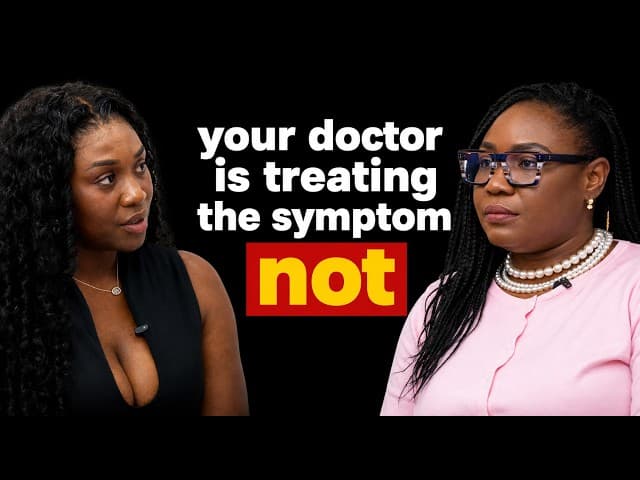
Some conversations don't just inform you. They give language to things you've felt but never knew how to name.
This interview with Dr. Faramade on the Deep Dives Podcast was one of those.
A dual board certified psychiatric mental health and family practice provider with over 15 years of clinical experience, she spoke as a clinician, but also as a mother, a founder, and a Nigerian woman who understands how culture and faith shape the way people carry pain. The episode wasn't really about mental health conditions. It was about the stories we attach to them.
The person who thinks they aren't praying hard enough because the depression won't lift. The man taught from childhood that boys don't cry. The family that calls schizophrenia witchcraft before they call it illness. Underneath all of it sat one quiet, powerful idea: mental health is not weakness, it is not always spiritual, and seeking help does not mean you've lost your faith.
When Faith Becomes the Only Explanation
In many African, immigrant, and deeply religious communities, mental health has rarely been treated as medical. It's been treated as spiritual. Someone is depressed, so they need deliverance. Someone hallucinates, so it must be a curse. Someone can't focus, so they're lazy.
Dr. Faramade didn't dismiss faith, she affirmed that prayer and spirituality have real value. But she drew a line that matters: some things are biological and clinical in nature, and no amount of prayer alone will resolve them. As she put it, faith without works is dead. If you've prayed over the same struggle for years and it hasn't moved, that may be the sign it was never spiritual to begin with.
The danger isn't faith itself. It's when faith gets used to silence pain instead of helping people face it. Because when every struggle is spiritualized, people feel ashamed for needing help, and they stay silent, convinced that seeing a doctor means failing God. It doesn't. Prayer, therapy, medication, community, and education can all belong in the same healing journey.
When Anxiety Isn't Just "Worry"
One of the most grounding moments was how she connected mental health to ordinary life. Life is a cycle, she explained, one decision shapes the next, and stress ripples through everything.
Financial pressure is a perfect example. The bills are due, the collectors are calling, and anxiety sets in. The body answers with a racing heart and rising blood pressure. Then you look at your children, wondering how you'll feed them, and your mood drops, and that low mood is where depression begins.
This is why her dual background in family practice and psychiatry matters so much. She doesn't just treat the blood pressure; she looks at the life behind it. Because a patient may never say "I'm anxious." They'll say "my heart keeps racing" or "I can't sleep." Sometimes the body tells the story the mouth hasn't found words for yet.
ADHD, Self-Diagnosis, and the Case for Real Assessment
The conversation also turned to ADHD, especially among high functioning adults. Since the pandemic, more people are wondering whether their lack of focus, procrastination, or racing thoughts might be ADHD. That curiosity can be useful; many adults were genuinely missed as children. But Dr. Faramade made a key point: walking in convinced you have ADHD doesn't mean you'll walk out with that diagnosis.
Sometimes it's ADHD. Sometimes it's anxiety, depression, PTSD, or chronic stress wearing the same mask. If your thoughts race all day, how much are you really concentrating? If your mood is on the floor, how much focus is left? The answer isn't to ignore your instincts, it's to refuse a rushed label and find someone who listens deeply enough to understand what's actually happening. Awareness is good. Self diagnosis isn't the same as clinical diagnosis.
Depression, Grief, and the Pain That Won't Move
Grief is a natural response to loss. But Dr. Faramade explained how grief can slide into depression when it stops moving, when the sadness lingers so long it starts shutting down a person's ability to function. They can't get out of bed. They cancel everything. They're still crying about something from four years ago, long after everyone around them expects them to be "over it."
This is where compassion becomes clinical. People love to say "just get up." But sometimes the person physically can't, depression has taken their motivation and energy, and what they need isn't a lecture but a hand. Sometimes that's therapy or medication. Sometimes it's a friend who simply says let's go for a walk, or family who notices the cancelled plans before things get worse. Depression is not laziness, and grief should never be rushed just because it makes other people uncomfortable.
Trauma: You Don't "Get Over" It, You Go Through It
When asked whether someone can "get over" their triggers, Dr. Faramade gently pushed back on the phrase. People don't get over trauma, she said. They go through it.
The distinction is everything. "Getting over it" means burying the pain and pretending it's gone. "Going through it" means facing the discomfort, understanding the trigger, and building a healthier response, because the event genuinely happened and won't be erased. Trauma isn't only combat. It can be abuse, a car accident, or childhood harm, and it lives in the body long after the moment passes. One of her clients couldn't tolerate a red carpet in her home, because the room where she was assaulted had red carpet. Others can't step into an elevator. They aren't being dramatic; they're responding from memory and survival. Healing doesn't mean the trauma never happened. It means it no longer controls every room you walk into.
Schizophrenia and the Damage of Stigma
Schizophrenia may be the most misunderstood and stigmatized condition she discussed. First, the correction: it is not "multiple personality." The word itself comes from the Greek for split mind, but it describes a disruption of thought, not a second persona. It can involve hallucinations (most often hearing voices no one else can hear), delusions like paranoia or grandiosity, and changes in how a person perceives reality, tied to neurotransmitters like dopamine. And despite what families often assume, there's no single gene you can point to and call the cause.
This matters most in communities where schizophrenia gets spiritualized or mocked. Someone hearing voices is already frightened; someone convinced they're being hunted is already overwhelmed. When the family responds with shame or accusations of witchcraft, the person only becomes more isolated, and isolation makes the illness harder to manage. Education, acceptance, and family support change outcomes. A family can pray and help someone get evaluated. A church can believe in God and welcome mental health professionals into the room.
Men's Mental Health and the Cost of "Man Up"
Some of the most moving moments came around men's mental health. Dr. Faramade traced the problem back to the cradle. When a little girl falls, she's scooped up and comforted. When a little boy falls, he's told to stand up and stop crying. Her own grandmother used to say boys don't cry, they sweat.
Over years, that lesson hardens. Sadness becomes weakness, fear becomes shame, and by adulthood many men carry everything in silence, which is exactly why men seek help far less than women, often at terrible cost. A man can be responsible and still be overwhelmed. He can provide and still need support. He can lead and still cry.
The turning point in her own home came when her young son said something the family never expected: boys need compliments, too. They'd been showering praise on his sister without noticing. That one sentence is worth holding onto. Boys need comfort and emotional language and safe spaces to be human, long before they become men who feel forced to suffer alone.
Medication: Two Things Can Be True
Her take on psychiatric medication was refreshingly balanced. Medication can save lives. Medication can also be handed out too fast when a system rewards volume over depth, the same dynamic, she noted, behind the opioid epidemic. Both can be true at once.
The real issue is quality of care. In a profit driven setting, a provider might see fifteen patients a day, leaving no time to go deep. That's exactly why she built her own practice around an hour for new patients and thirty unhurried minutes for follow ups. She's clear with patients that every medication has side effects, that they should flag any supplements they're taking, and that they are the ones who ultimately have to advocate for themselves. A therapeutic relationship is still a relationship, if a provider isn't listening, you're allowed to find one who will. The goal isn't to shame medication. It's to use it responsibly, with real assessment and follow-up.
The Founder's Journey: "I'm the Structure Now"
Beyond the clinic, Dr. Faramade spoke candidly about building a business while being a wife, a mother, and a daughter to aging parents. The scariest part of going independent wasn't the money, it was becoming the final decision maker. In a larger organization, the structure already exists. As a founder, she said, I'm the structure now.
Her answer was to anchor everything in quality. She'd rather see fewer patients well than rush people through a system, because in healthcare the metric can't only be profit, it has to be whether people are actually getting better. It's a lesson that travels well beyond medicine: when you build something of your own, you become responsible for the process, the people, and the standard. None of it was easy. But she credits steady support, a husband and family who believed in her on the days she couldn't believe in herself, for making it possible.
The Real Lesson: Be Careful With People
Near the end, Dr. Faramade left a reminder that holds the whole episode together: be mindful of how you present yourself, and of the words that leave your mouth, because you never know what someone is carrying.
She pointed to Chadwick Boseman, who was quietly battling cancer while strangers online criticized how thin he looked, never knowing what he was enduring. We rarely know who's grieving, who's hearing voices, who's praying every night and still struggling every morning, who's one cruel comment from the edge. That's why language matters. Compassion matters. Too many people are already at the edge, and they don't need more shame. They need understanding, honesty, and access to care.
Because the better question was never what diagnosis does this person have? It's what have they been carrying, and how can we meet it with more wisdom and grace? Mental health, in the end, isn't only a clinical conversation. It's a human one.
Watch the full conversation with Dr. Faramade on the Deep Dives Podcast and join the conversation in the comments.