
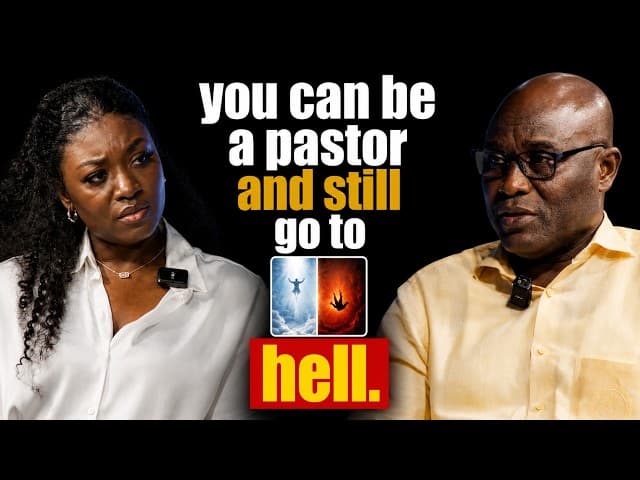
Some interviews stay with you because of what was said. Others stay with you because of what they force you to ask about yourself.
My conversation with Pastor Kobby on the Deep Dives Podcast was the second kind.
It wasn't really a discussion about church or theology. It was about the gap between what people say they believe and how they actually live, the questions a lot of us carry quietly but rarely say out loud. Why do Christians sometimes hurt people the most? Why does the church preach grace but run short on patience? Can you serve in ministry and still be far from God?
Pastor Kobby didn't soften it: you can be a Christian and still go to hell. You can stand behind a pulpit, preach, lead, serve and still be disconnected from the heart of God.
It's an uncomfortable sentence. That's exactly why it's worth sitting with.
Looking Holy Without Becoming Whole
The strongest thread in the interview was the difference between appearing religious and actually walking with God.
There's a version of Christianity that knows how to dress the part, quote Scripture, attend church, and perform holiness in public. Pastor Kobby challenged the assumption that outward religion is the same thing as inward change.
This is why so many people quietly walk away from church. Often, it isn't that they hate God. It's that they've seen too much contradiction from the people claiming to represent Him: leaders who preach purity and live double lives, members who judge harshly while hiding their own brokenness, spiritual language without spiritual maturity.
That kind of hypocrisy doesn't just damage reputations. It damages trust, and in a spiritual setting, that wound goes deep.
His point wasn't that Christians have to be perfect. He admitted plainly that even pastors get it wrong. The issue isn't falling. The issue is pretending you never fall.
The Church Needs More Patience, Not More Judgment
One of the most pointed moments came when Pastor Kobby described how the church treats people who are still growing. His take: the church is often too quick to judge and too slow to be patient.
That lands, because nobody walks in already healed. People show up carrying pain, addiction, shame, fear, and unfinished questions. When a church says "come as you are" and then punishes people for actually coming as they are, it creates a contradiction people can feel.
He framed the church's job as washing people with the water of the Word, not crushing them with judgment. That doesn't mean ignoring truth or skipping accountability. It means treating transformation as a process that takes time.
Faith communities shouldn't be places where people get publicly shamed for being mid-journey. God's patience isn't permission to stay the same. It's an invitation to keep moving.
"Chief Servant" Is a Posture, Not a Title
Pastor Kobby calls himself "chief servant," not bishop, not apostle, not senior pastor. His reasoning was simple: being a servant means he always has a boss to answer to, and that keeps him humble.
That one choice says a lot about leadership.
The higher you climb, the more dangerous pride becomes. When people honour you, follow your teaching, and trust your voice, it gets easy to forget that leadership is stewardship, not ownership. A pastor isn't the source. He's a steward.
And the principle reaches past the pulpit. In business, family, and community, the healthiest leaders aren't the ones obsessed with being seen; they're the ones who treat people as souls and assignments to be handled with care, not props for a platform. A title can open a door. Character decides whether you should have been trusted with it.
Faith You Live, Not Just Faith You Argue
A big stretch of the conversation dealt with the hard questions, science, other religions, and the parts of Scripture that don't resolve neatly.
What stood out is that Pastor Kobby didn't pretend to have a tidy answer for every mystery. He admitted there are passages that still make him ask questions. There's something disarming about a faith leader who can say, "There are things I'm still praying to understand". Faith isn't the absence of questions. It's seeking God through them.
When the talk turned to speaking with atheists, Muslims, or skeptics, his emphasis wasn't winning the debate; it was personal experience. People aren't always moved by arguments. They can argue with your interpretation, but it's much harder to dismiss what God has actually done in your life. Apologetics and study have their place. So does a life that's visibly been changed.
Church Hurt Is Real, and Ignoring It Doesn't Heal It
The interview didn't dodge the painful side of religious institutions: abuse, cover-ups, and the way people keep following leaders and systems long after trust has been broken.
For a lot of people, church hurt isn't a buzzword, it's a lived experience of betrayal, manipulation, spiritual control, or being dismissed for asking honest questions. When someone leaves the church because they were harmed, "you should have had more faith" isn't an answer. Sometimes the honest response is: I'm sorry that happened. That should not have happened. God was not honoured in that.
Pastor Kobby drew a clear line between God and the people who misrepresent Him. That distinction is true, but for someone who's been wounded, it takes time to untangle the two. Which is why spiritual communities need more than good preaching. They need accountability, transparency, and the willingness to confront wrongdoing instead of protecting an image. When institutions guard their reputation more than their people, they forfeit moral authority.
Christianity Was in Africa Before the Missionaries
One of the most clarifying parts of the conversation was Christianity and Africa.
Many people wrestle with how faith got tangled up with colonization and missionary history. It's a fair tension. But Pastor Kobby pushed back on the idea that Christianity only arrived in Africa through white missionaries, pointing to the account of Philip and the Ethiopian official in Scripture, who carried the faith back to Africa long before Europe ever showed up.
It complicates the simple story in a useful way. Yes, colonial power shaped how Christianity spread. And yes, faith took root on the continent through African voices, far earlier and far deeper than the "imported religion" narrative allows. The real question isn't whether African Christianity is legitimate. It's how African Christians keep reclaiming the faith with cultural honesty and truth.
Salvation Isn't Just an Escape Plan
One of the sharpest turns came when Pastor Kobby challenged the idea that people only become Christians to dodge hell. His answer: salvation isn't just a ticket out, it's about how you live now.
That's a needed correction. When faith gets reduced to fear, you get people who are religious but not transformed. They pray the prayer and claim the identity but never actually become more honest, patient, or kind. Fear can grab someone's attention. Love and truth are what reshape a life.
His emphasis on righteousness pulls everything back to daily reality: How do you treat people? Are you honest when no one's watching? Do you repair the harm you cause? Christianity was never meant to be a label. It was meant to become a way of life.
The Real Question: Are You in Church, or in God?
Near the end, Pastor Kobby said the line that holds the whole episode together:
"Many are in church, but only few are in God."
It's uncomfortable because it demands self-reflection. It's easy to measure faith by attendance, titles, and service roles, none of which reveal the condition of the heart. Being in church can be beautiful and necessary. It's still not the same as being surrendered to God.
So the deeper question isn't do I identify as Christian? It's is my life actually becoming more like Christ? And that question isn't just for pastors. It's for the person hurt by church and finding their way back. For the one who serves every Sunday but is quietly burned out. For the skeptic watching from the outside, wondering if any of this is real.
The answer was never going to be found in performance. It's found in fruit.
You can carry the title and still miss the heart. You can be in the building and still be far from God. Maybe that's the real invitation of this conversation, not to decide who's "in" or "out," but to ask ourselves honestly: Am I just around faith, or am I being changed by it?
Watch the full conversation with Pastor Kobby on the Deep Dives Podcast and tell us where you land in the comments.